



DIY led light for aquascape from A to Z and things you shouldn’t miss

Building your own DIY led light for aquascape not only saves you money but also gives you the flexibility to customize the lighting to suit the needs of different plants and fish. However, this process requires a basic understanding of electricity, lighting, and installation techniques. In this article, Terrarium Vibe will guide you through the entire DIY led light for aquascape project from A to Z and highlight the key points you shouldn’t overlook.
Pros and cons of DIY led light for aquascape
DIY led light for aquascape has become a popular choice among aquarists. While it offers clear benefits in cost savings and customization, it also comes with potential risks if you lack technical knowledge or skills.
Advantages of DIY led lights
Making your own led light allows you to adjust both intensity and light spectrum to meet the specific needs of your aquatic plants. Plus, the upfront cost is usually much lower than buying commercial specialized lights. It’s also a great chance to develop your technical skills and express creativity through designing and assembling your lighting system.

Advantages of DIY led lights
Disadvantages of DIY led lights
DIY led lighting requires basic knowledge of electricity and lighting principles. Incorrect calculations of spectrum or wattage can stunt plant growth or encourage unwanted algae. Poor heat dissipation or wiring errors can cause shorts or fires, risking damage to your tank and home electrical system.
Simple and easy steps to DIY led light for aquascape
Creating your own led light is not complicated if you understand the process and prepare the right materials. Here are the basic steps to help you build an effective lighting system for your aquascape that supports plant photosynthesis while keeping costs low.
Design a simple electrical circuit diagram
This first step is crucial. You need to:
- Determine the number of LEDs based on your tank size
- Choose suitable LED types (white, red, green) and their operating voltage
- Arrange LEDs in parallel or series circuits
- Calculate the proper resistor to protect LEDs from excess current
A careful design prevents electrical shorts and ensures a stable system.
Install frame and heat sink for the lighting system
The frame and heat sink play an important role in extending the lifespan of your LEDs. Consider:
- Using aluminum bars or other good heat-conducting materials for the frame
- Securing LEDs firmly to the frame with thermal adhesive or screws
- Designing the frame for easy mounting on the tank rim with a neat appearance
- Adding cooling fans if you’re using high wattage LEDs
- This step helps avoid overheating and prolongs LED chip life.
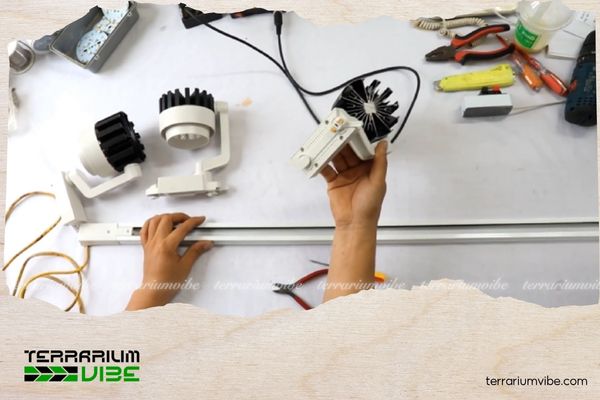
Install frame and heat sink for the lighting system
Wire, secure, and test the lighting system
Once the frame and LEDs are in place, solder the wires carefully to ensure stable, safe connections. Cover solder joints with electrical insulation to prevent shorts. Attach the power supply and firmly mount the entire assembly on the tank with brackets or sturdy materials. Finally, power it on and check brightness, temperature, and light stability, adjusting as needed.
Common mistakes in DIY led light for aquascape and how to fix them
Aquascape enthusiasts often face some typical technical issues that can affect lighting efficiency or damage the tank ecosystem if not handled properly:
- Choosing the wrong light spectrum: slows plant growth
- Skipping resistors: causes LEDs to burn out
- Poor heat dissipation: overheats and damages LEDs
- Bad soldering: leads to electrical shorts
- Placing LEDs too close to water: causes reflections and raises tank temperature

Choosing the wrong light spectrum: slows plant growth
Frequently asked questions about DIY led light for aquascape
Is it necessary to use specialized LEDs for aquascapes?
Not mandatory but highly recommended. Specialized LEDs offer a spectrum better suited for aquatic plant photosynthesis. If using regular LEDs, pick ones with a color temperature around 6000K to 7000K and add red and green LEDs to support plant growth.
How to know if my DIY led light is bright enough for plants?
The simplest way is to observe plant growth rate and algae appearance. You can also use a lux meter or PAR meter to measure actual light intensity and adjust the number of LEDs or lighting duration accordingly.

How to know if my DIY led light is bright enough for plants?
Should I combine multiple LED colors in one system?
Yes. Mixing white, red, blue, and green LEDs better mimics natural light, supporting comprehensive plant development and enhancing the tank’s aesthetics. Just make sure to balance the ratio to avoid visual overload or disrupting the tank ecosystem.
DIY led light for aquascape is an effective solution to save costs and create the perfect lighting tailored for your plants and fish. We hope Terrarium Vibe’s detailed guide helps you successfully build and maintain a healthy, beautiful aquascape.